Boulder & Natural Stone Retaining Walls in Topeka, KS
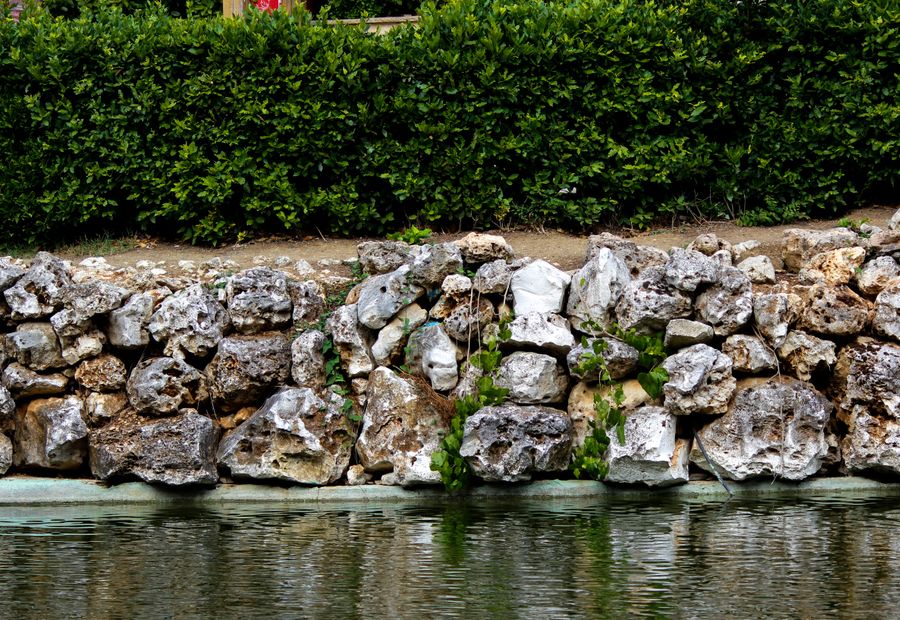
Topeka Retaining Walls builds boulder and natural stone retaining walls on sloped yards, creek banks, driveway cuts, and garden terraces in Topeka, Tecumseh, Auburn, Berryton, and across Shawnee County, Kansas. Our crew lays quarried limestone, weathered outcropping boulders, and glacial fieldstone, dry or in mortar, and the same landscaper handles the planting and grade work around the finished wall.
Limestone is the local answer here, and the reason is freight. The Flint Hills roll west of Topeka on thin limestone ground, and that rock reaches this market from close by instead of across two states. Big stone goes in with a machine and a thumb, one piece at a time, each one turned until it beds on two points of the stone beneath rather than teetering on one. The base course sits in a trench below finished grade, so the toe locks into the ground before any height goes up. Behind the face we place washed angular drainage stone, filter fabric, and a pipe on a fall. Compare a wall of rock rolled onto the lawn with clay tucked in behind it. No toe, no outlet, and clay that swells and shrinks twice a year working on both faults.
Mass Does the Work
Nothing pins one boulder to the next and no grid runs into the hill. Weight holds the wall, helped by the batter that leans each course back into the slope. Stone size therefore matters more than stone shape. A tall face built from small rock fails where the same face in large rock stands for generations.
Laying Stone Dry
Flat quarried stone goes down in courses with the joints staggered and the face pitched slightly back into the bank. Smaller stone chinks the gaps where a face needs bearing. Every piece touches the two below it. Nothing floats on soil and nothing rests on a single point of contact.
Why Stone Bellies Where Block Leans
Pins and grid tie a block wall into one connected system, and that system tips as a whole. Stone has no such ties. Each piece stands alone, so the hill hunts for the softest run of stone and bellies it outward while both ends hold their line. Read that belly as a map. Water is pooling right there. We open that stretch, rebuild the stone column behind it, and relay the face from the base up.
Booking
Stone goes slower than block and we schedule it honestly. Site visits happen in any month. The machine sets rock after the frost clears. (785) 555-0117 reaches us.
Dry-laid or mortared stone, which should I have?
A dry-laid wall holds by weight, friction, and how each stone beds on the ones under it, and water walks straight through the face. A mortared wall gives you a solid, tidy face that takes a cap or a sill well, but it dams water, so it needs weeps and a real drain behind it. Garden banks and creek edges suit dry-laid work. A formal entry or a low seat wall at the front door suits mortar.
How tall can a boulder wall go without reinforcement?
A gravity wall holds by mass, so its height comes from stone size and from how far the wall sits back into the slope. Machine-set boulders on a buried base course handle most residential grade changes on their own. Past that point there are two honest answers: split the grade into two walls with a bench between, or have a design done with reinforcement in the fill. In Topeka a permit comes in above four feet, and the tallest walls need an engineer's seal.
What stone do you use around Topeka?
Limestone leads, since it is the ranch country rock of the Flint Hills west of here and it moves to this market cheaply. It beds flat, weathers to a soft grey, and comes in everything from outcropping boulders down to hand-set flats. We also set glacial fieldstone when a client wants rounder shapes, though round stone beds badly and takes longer to lay.
Does a stone wall need drainage behind it?
It does. The face may pass water, but the fill behind it still holds it, and Kansas clay holds it well. Clean angular stone goes against the back of the wall, filter fabric separates it from the native soil, and a perforated pipe carries the water out to daylight. Dry-laid work treats that stone column as cheap insurance. Mortared work depends on it, because a solid face with no drain behind it becomes a dam.